Encouraging Seattle exploration through curated light rail zines

Role
Role
UX Researcher
Illustrator
UX Researcher
Illustrator
Team
Team
4 Designers
4 Designers
Timeframe
Timeframe
Jan – March 2026
Jan – March 2026
8 weeks
8 weeks
Tools
Tools
Adobe Illustrator
Figma
Procreate
Adobe Illustrator
Figma
Procreate
Overview
Off-Rail: uncovering hidden spots of Seattle's light-rail neighborhoods
Off-Rail is a design solution that transforms the "logistical tax" of commuting into an opportunity for social discovery. By activating Seattle light rail stations with neighborhood-specific zines, the project encourages those in Seattle to break the "Seattle Freeze" and build deeper connections with the city’s informal gathering spots.


Context
Why does exploring a new city and finding community feel so exhausting for Seattle’s young professionals?
Seattle is a rapidly growing city of transplants who frequently experience social isolation and feel disconnected from the culture of their new neighborhoods. We chose to focus on this space because young professionals want to build community, but they constantly struggle to overcome the daunting initial barriers of effort, cost, and time required to actively explore an unfamiliar city.


Initial Research
Cracking the “Seattle Freeze”
To understand our demographic and key challenges better, I led our team through a series of semi-structured interviews with eight participants. We recruited a mixture of recent Seattle transplants, long-time residents, and small business owners.
Here were our key participants:
To understand our demographic and key challenges better, I led our team through a series of semi-structured interviews with eight participants. We recruited a mixture of recent Seattle transplants, long-time residents, and small business owners.
Here were our key participants:

Boba
Seattle resident of 4 months
Works hybrid for a professional services firm
Seattle resident of 4 months
Works hybrid for a professional services firm

Cake
Seattle resident of 10 years
Works remotely for a technology startup
Seattle resident of 10 years
Works remotely for a technology startup

Coffee
Seattle resident of 20+ years
Owner of popular small business in Seattle
Seattle resident of 20+ years
Owner of popular small business in Seattle

Tomato
Seattle resident of 2 years
Works hybrid for a global technology company
Seattle resident of 2 years
Works hybrid for a global technology company
Because I have to account for transit time, I'm less willing to just do things on the fly. If I don't already have plans made, I’ll just stay home.
The barrier to go out and explore a third space has to be incredibly low, because trying to get past shallow talk and make deeper connections here in Seattle is already hard enough.
-Tomato
Interviewees expressed a strong desire for novelty and community, but felt hindered by the high “logistical tax” of socializing in Seattle. Between the effort of planning around transit schedules, the financial burden of going out, and the pressure of initiating conversations, retreating to the comfort of home often became the easiest choice.
It became clear that our solutions needed to be low-pressure, seamlessly integrate into their existing daily routines, and lower the barrier to shared neighborhood exploration.
Interviewees expressed a strong desire for novelty and community, but felt hindered by the high “logistical tax” of socializing in Seattle. Between the effort of planning around transit schedules, the financial burden of going out, and the pressure of initiating conversations, retreating to the comfort of home often became the easiest choice.
It became clear that our solutions needed to be low-pressure, seamlessly integrate into their existing daily routines, and lower the barrier to shared neighborhood exploration.
Synthesis
Defining our solution space
Based on our research, I identified three insights to use as guiding stars in our design solution, and developed a solution statement that reflected these findings.
Decision paralysis
Fatigue from the decision-making process of everyday life makes isolation the easier choice over high-pressure social situations.
Novelty and familiarity
People crave the novelty of a new crowd but rely on the familiarity of a trusted friend to mitigate the risk of entering the space alone. This safety net becomes a barrier.
Digital vs. physical
Digital spaces merely maintain connections while physical spaces strengthen those bonds through sharing of experience. However, because "logistical tax" is high, face-to-face interaction shifts from habit to a high-pressure planned event.
How might we design low-pressure, shared third-place experiences that help Seattle residents overcome the barrier of exploring their city and build local belonging and meaningful connections?
Ideation
Brainstorming high-level concepts
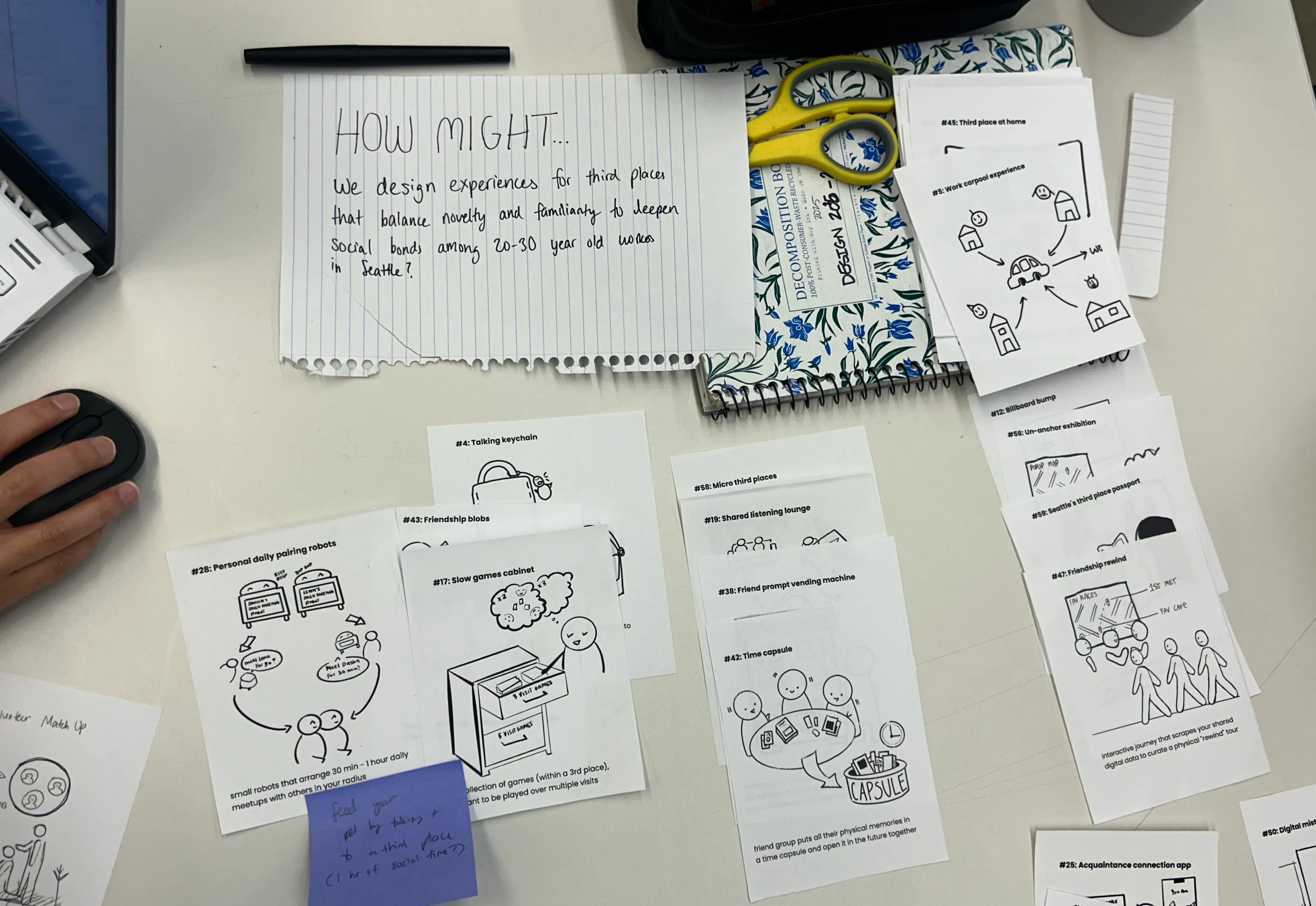
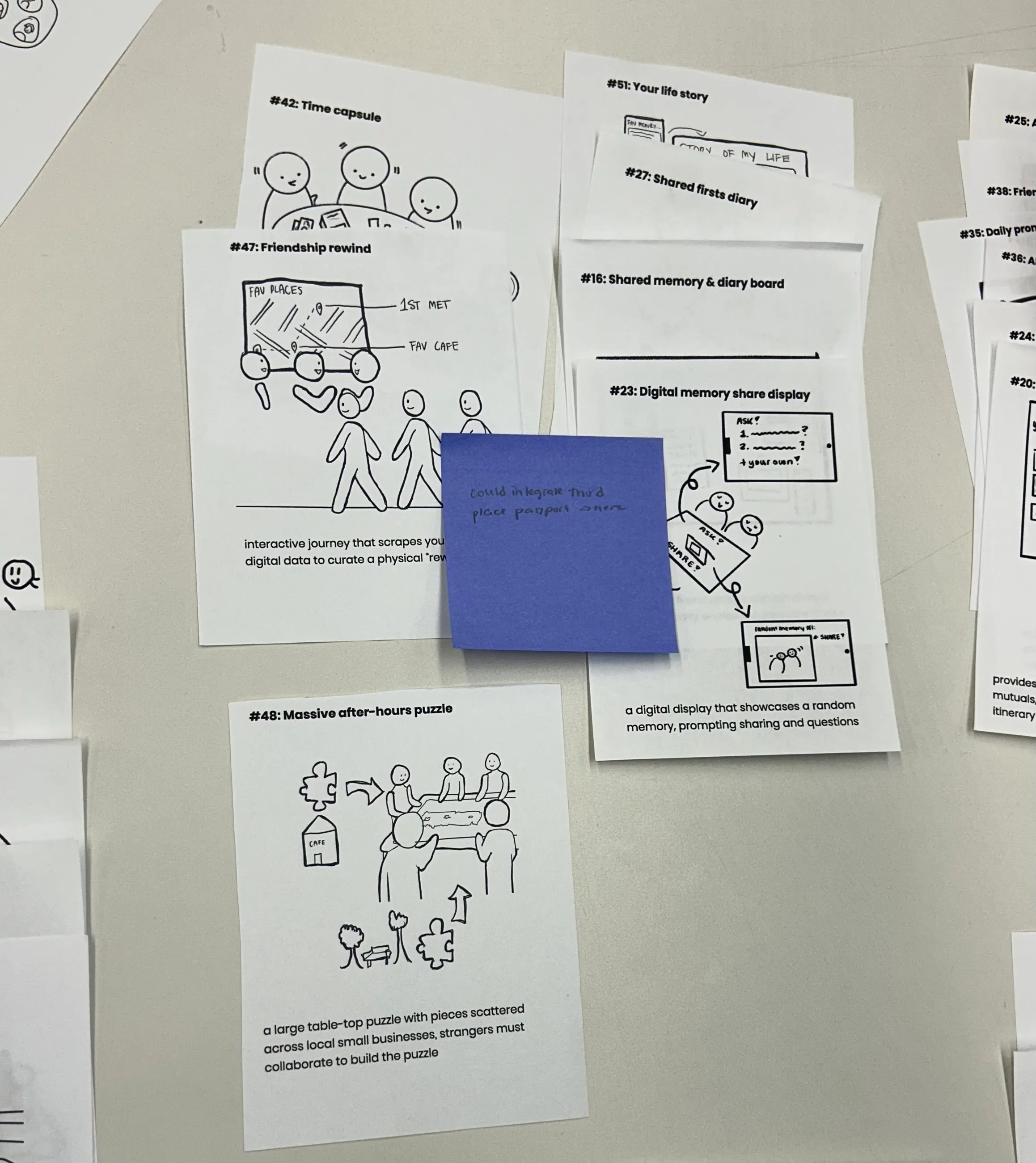
After establishing our solution statement and insights/design principles, we rapidly sketched 60 potential solutions (15 each!), focusing on creativity and concept rather than a perfect solution.


After gathering our ideas together, we did a general “vibe check,” identifying which concepts excited us and which should be discarded. We also discarded ideas that felt “incomplete,” either because they didn’t address our How Might We properly, or required additional features.
We then grouped similar ideas together by theme, evaluating the rest of the ideas through the lens of insights and pain-points we identified through our original contextual inquiry.
After gathering our ideas together, we did a general “vibe check,” identifying which concepts excited us and which should be discarded. We also discarded ideas that felt “incomplete,” either because they didn’t address our How Might We properly, or required additional features.
We then grouped similar ideas together by theme, evaluating the rest of the ideas through the lens of insights and pain-points we identified through our original contextual inquiry.
Downselection
From 60 ideas to 1 core concept


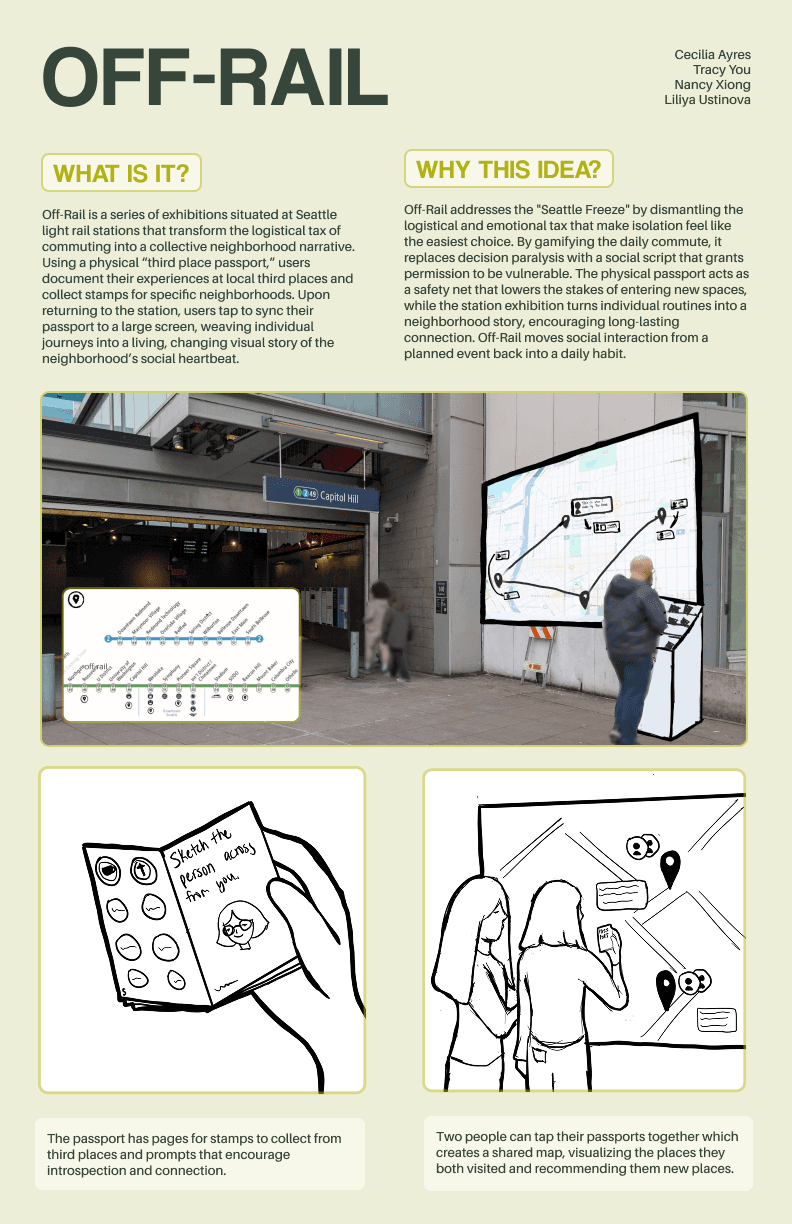
Off-Rail initial concept: third place "passport" + large jumbotron to "scan" your passport in, creating a neighborhood map
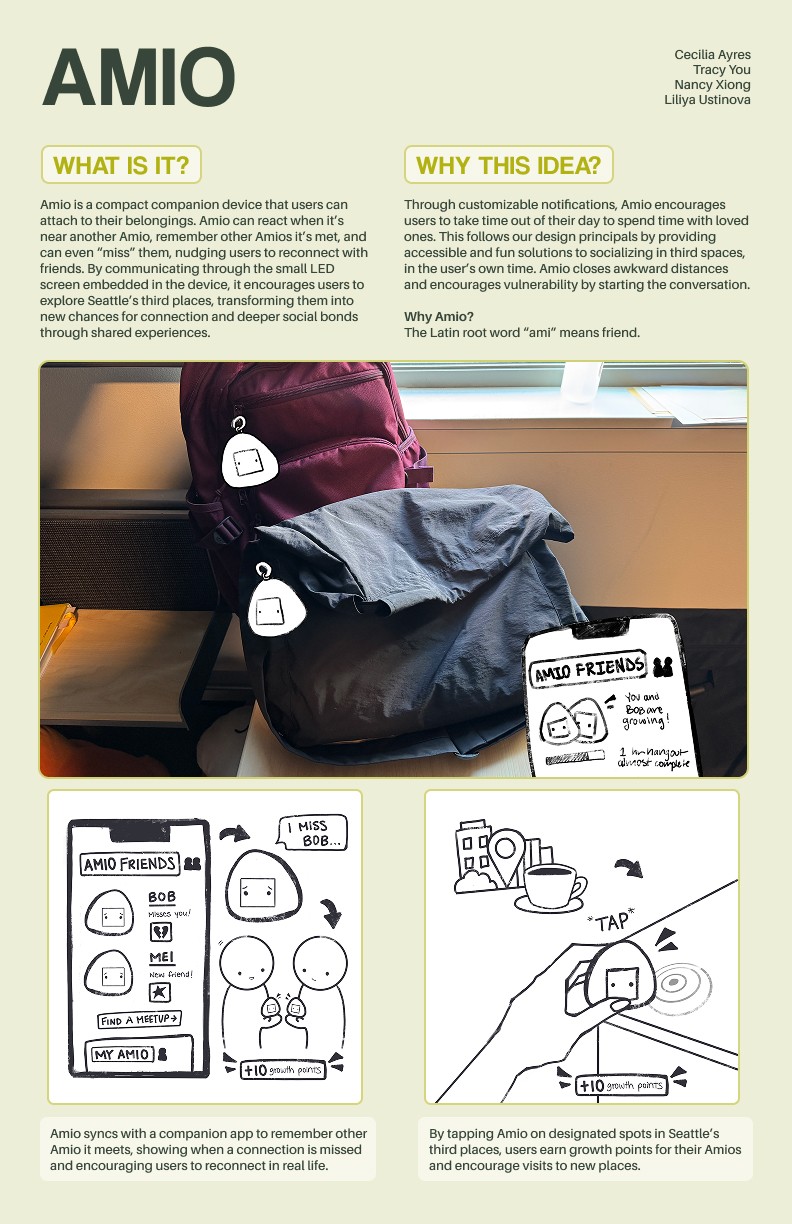
We narrowed down the initial 60 concepts to 3 main ideas. Our first concept, Amio, was a Tamagotchi-style keychain that nudged users to connect with their friends. However, one user stated the "cute" form factor and nudging would annoy them after a long day of work. This feedback pushed us to empathize strongly with our demographic, even if we were more biased towards an idea.
We decided to go with our concept of Off-Rail as it directly addressed the issue of convenience and accessibility, utilizing the existing transit system in place in Seattle while also helping foster social connections.
We narrowed down the initial 60 concepts to 3 main ideas. Our first concept, Amio, was a Tamagotchi-style keychain that nudged users to connect with their friends. However, one user stated the "cute" form factor and nudging would annoy them after a long day of work. This feedback pushed us to empathize strongly with our demographic, even if we were more biased towards an idea.
We decided to go with our concept of Off-Rail as it directly addressed the issue of convenience and accessibility, utilizing the existing transit system in place in Seattle while also helping foster social connections.
Participatory Design
Co-designing with our users
To further refine our Off-Rail idea, I led two participatory design workshops with two Seattle workers who regularly use the light-rail to help shape a stronger central idea. Through activities focused on drawing/moodboarding, roleplaying, and responding to scenarios, we gained valuable insights into our design direction.


Feedback revealed that our initial idea of a large screen/jumbotron at each station, creating a neighborhood map, felt too "gimmicky" and public. Our users liked the form factor of the passport, however, preferring a light, easy-to-read product. They enjoyed that the product was low-pressure and sparked interaction without feeling restrictive. Additionally, they also emphasized they would want this product to have playful branding that feels uniquely "Seattle."
This led us to simplify the concept into an easy-to-read physical zine with neighborhood-specific branding that encourages shared exploration and connections.
Feedback revealed that our initial idea of a large screen/jumbotron at each station, creating a neighborhood map, felt too "gimmicky" and public. Our users liked the form factor of the passport, however, preferring a light, easy-to-read product. They enjoyed that the product was low-pressure and sparked interaction without feeling restrictive. Additionally, they also emphasized they would want this product to have playful branding that feels uniquely "Seattle."
This led us to simplify the concept into an easy-to-read physical zine with neighborhood-specific branding that encourages shared exploration and connections.
User Feedback
Creating rough prototypes for user feedback
I created a low-fidelity prototype of a potential zine and other form factors we were exploring such as a brochure/pamphlet. I presented this physical prototype along with a storyboard to our two users to gain feedback on the physical form and the experience of the storyboard before proceeding with high-fidelity prototyping.

Our participants preferred the zine as it was more pocket-sized, discreet, and community-oriented. We also received valuable feedback on considering seasonality, as many Seattle activities depend on the season.
Final Concept
Zines centered around neighborhood exploration and shared experiences in Seattle
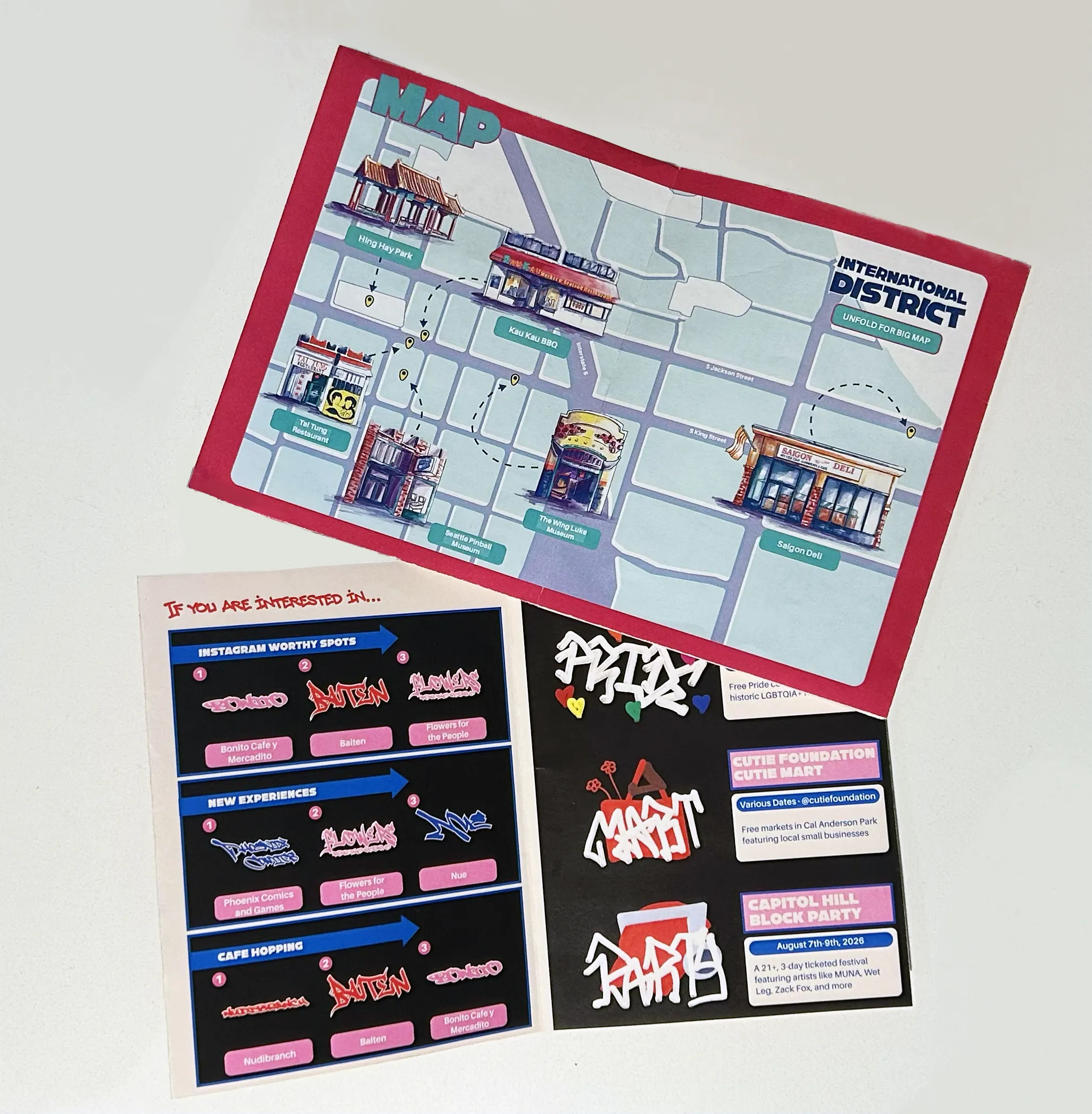
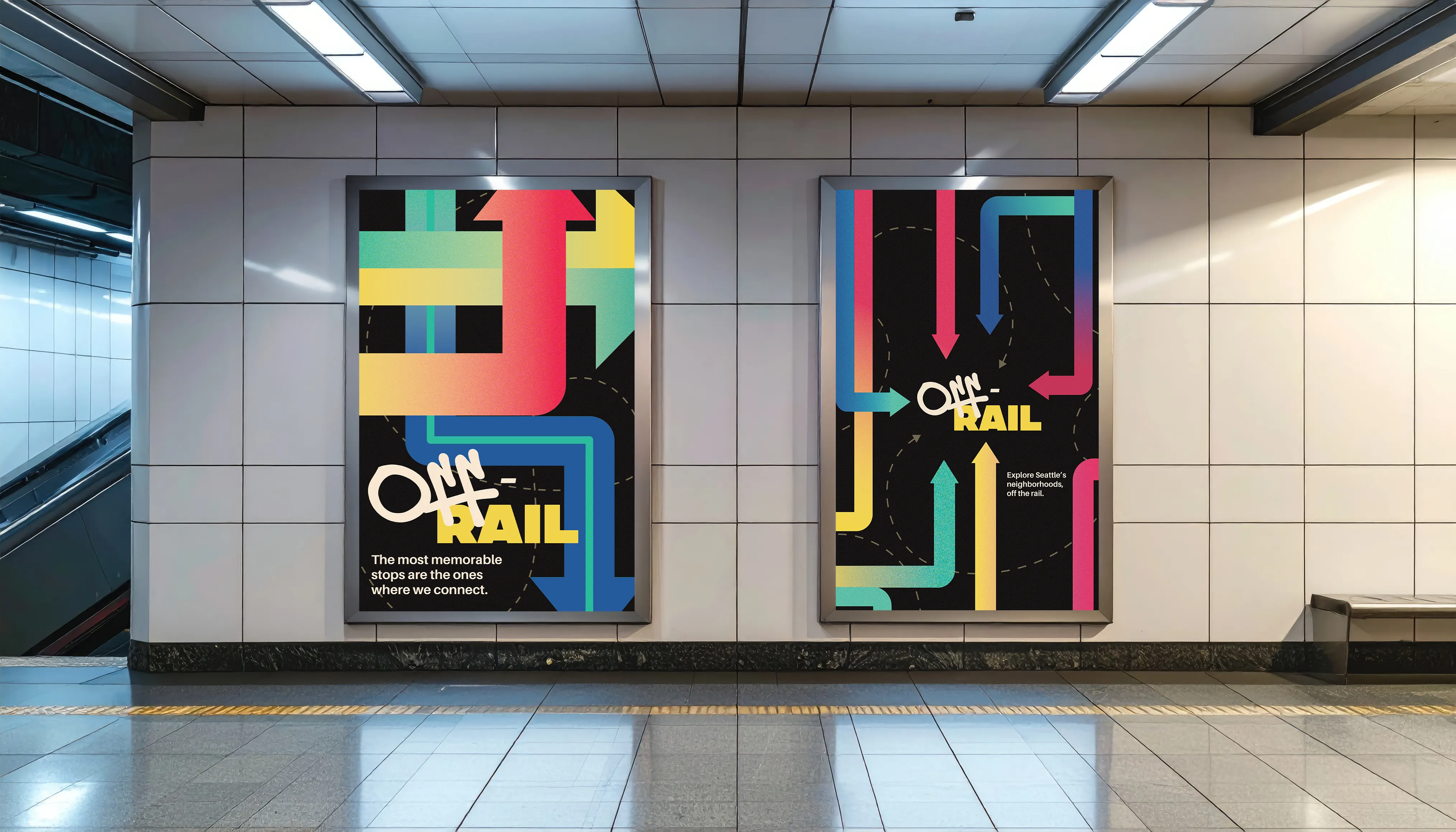
Off-Rail is a biannually updated series of transit zines designed to transform everyday Seattle light rail commutes into shared neighborhood explorations. Zines feature specific third places, contain information about upcoming events, and provide conversation starters through fun activities such as bingo and a reflection page.
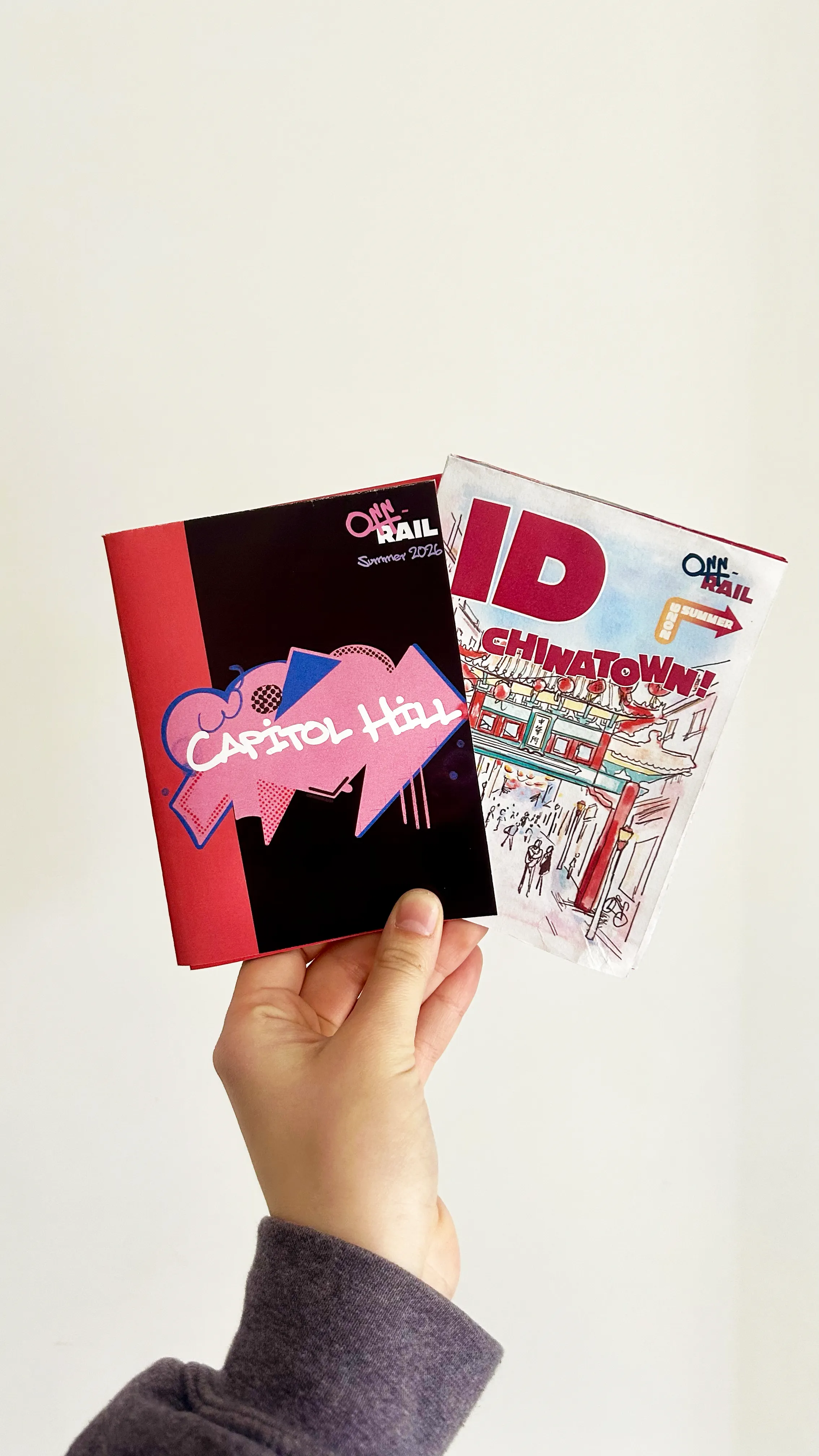
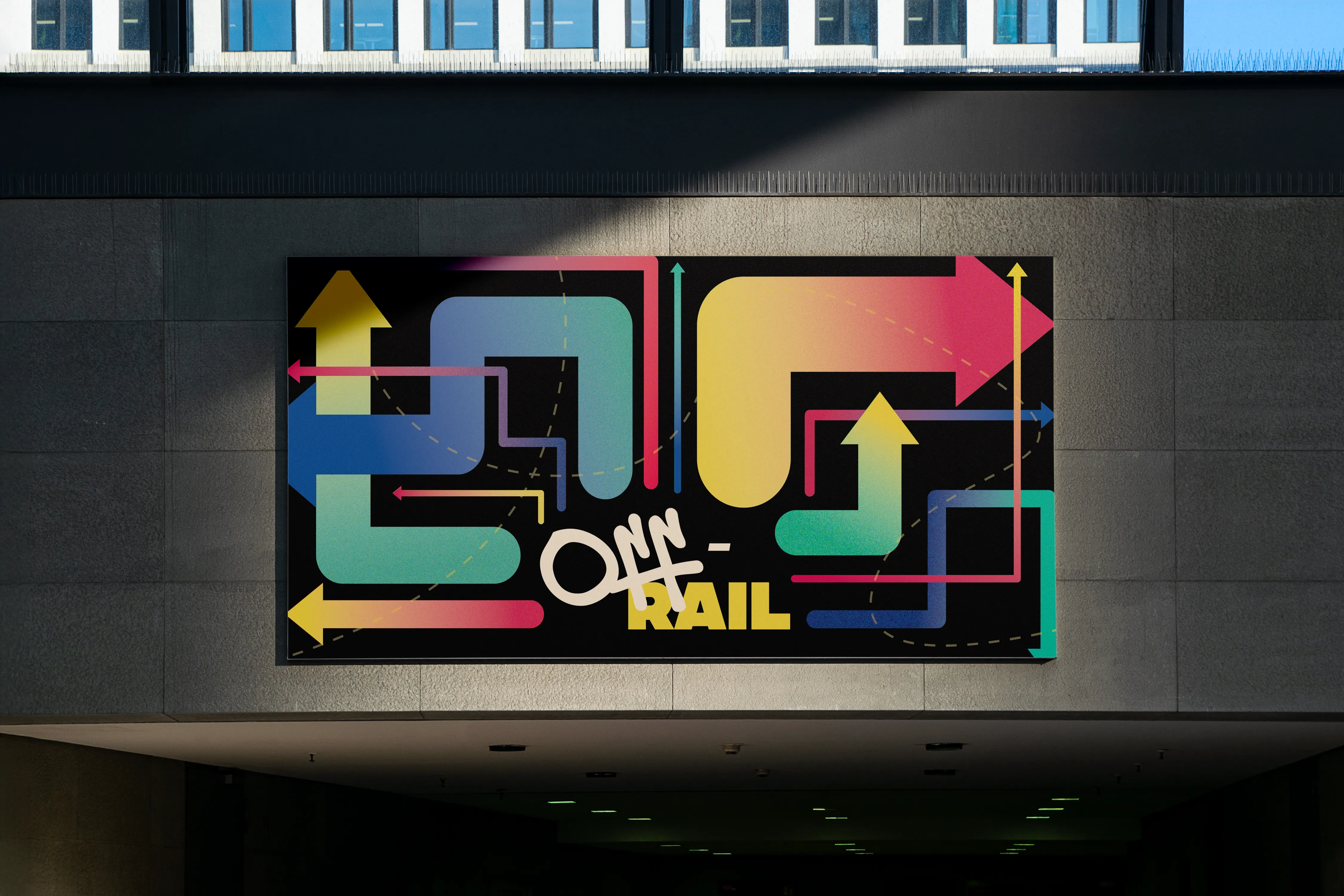
Our final deliverables included the overarching Off-Rail brand and advertising campaign, alongside two fully realized, uniquely branded zines for the International District and Capitol Hill.
Off-Rail is a biannually updated series of transit zines designed to transform everyday Seattle light rail commutes into shared neighborhood explorations. Zines feature specific third places, contain information about upcoming events, and provide conversation starters through fun activities such as bingo and a reflection page.
Our final deliverables included the overarching Off-Rail brand and advertising campaign, alongside two fully realized, uniquely branded zines for the International District and Capitol Hill.


Credits to Ceci Ayres and Tracy You for the overall branding of Off-Rail!
I illustrated the ID-Chinatown zine! Feel free to flip through here :)